|
 |
| |
1080P DOES MATTER – Here's When
(Screen Size vs. Viewing Distance vs. Resolution) |
I've read various articles debating the importance of the 1080p. I want to set the record straight once and for all: if you are serious about properly setting up your viewing room, you will definitely benefit from 1080p (and even 1440p.) Why? Because the 1080p resolution is the first to deliver enough detail to your eyeball when you are seated at the proper distance from the screen. But don't just take my word for it: read on for the proof.
There are a few obvious factors to being able to detect resolution differences: the resolution of the screen, the size of the screen, and the viewing distance. To be able to detect differences between resolutions, the screen must be large enough and you must sit close enough. So the question becomes "How do I know if need a higher resolution or not?". Here is your answer.
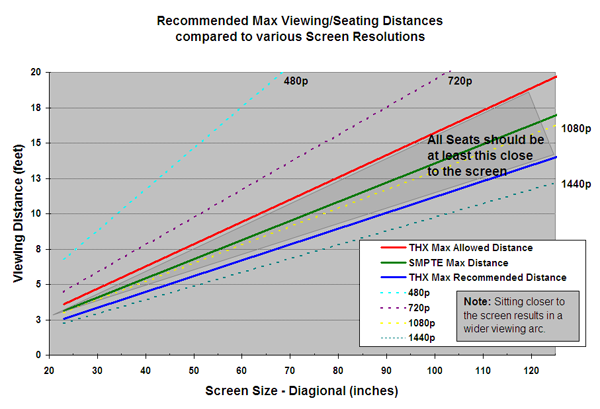
Based on the resolving ability of the human eye (with 20/20 vision it is possible to resolve 1/60th of a degree of an arc), it is possible to estimate when the differences between resolutions will become apparent. (Click the picture below for a larger version.) |
|
 |
| |
What the chart shows is that, for a 50-inch screen, the benefits of 720p vs. 480p start to become apparent at viewing distances closer than 14.6 feet and become fully apparent at 9.8 feet. For the same screen size, the benefits of 1080p vs. 720p start to become apparent when closer than 9.8 feet and become full apparent at 6.5 feet. In my opinion, 6.5 feet is closer than most people will sit to their 50" plasma TV (even through the THX recommended viewing distance for a 50" screen is 5.6 ft). So, most consumers will not be able to see the full benefit of their 1080p TV.
However, front projectors and rear projection displays are a different story. They make it very easy to obtain large screen sizes. Plus, LCD and Plasma displays are constantly getting larger and less expensive. In my home, for example, I have a 123-inch screen and a projector with a 1280×720 resolution. For a 123-inch screen, the benefits of 720p vs. 480p starts to become apparent at viewing distances closer than 36 feet (14 feet behind my back wall) and become fully apparent at 24 feet (2 feet behind my back wall). For the same screen size, the benefits of 1080p vs. 720p start to become apparent when closer than 24 feet and become full apparent at 16 feet (just between the first and second row of seating in my theater). This means that people in the back row of my home theater would see some improvement if I purchased a 1080p projector and that people in the front row would notice a drastic improvement.
So, how close should you be sitting to your TV? Obviously, you need to look at your room and see what makes sense for how you will be using it. If you have a dedicated viewing room and can place seating anywhere you want, you can use this chart as a guideline. |
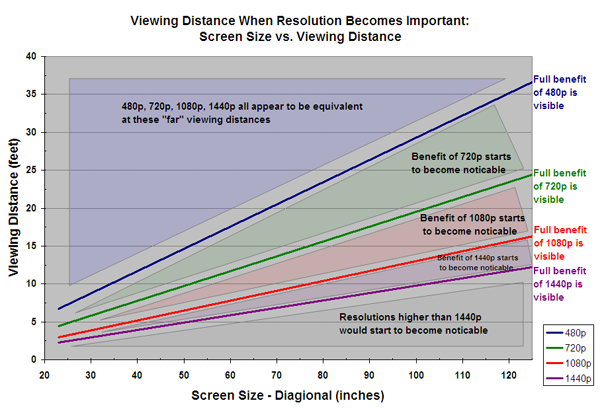 |
Looking at this chart, it is apparent that 1080p is the lowest resolution to fall within the recommended seating distance range. Any resolution less than 1080p is not detailed enough if you are sitting the proper distance from the screen. For me and many people with large projection screens, 1080p is the minimum resolution you'd want.
In fact, you could probably even benefit from 1440p. If you haven't heard of 1440p, you will. It is part of the HDMI 1.3 spec, along with 48-bit color depth, and will probably surface for the public in 2009 or so. The resolution benefits will be fully apparent if you are just a little closer. I've read of plans for resolutions reaching 2160p but I don't see any benefit; you'd have to sit too darn close to the screen to notice any improvement. If you sit too close, you can't see the far edges of the screen.
In conclusion: If you are a videophile with a properly setup viewing room, you should definitely be able to notice the resolution enhancement that 1080p brings. However, if you are an average consumer with a plasma on the far wall of your family room, you are not likely to be sitting close enough to notice any advantage. Also, the most important aspects of picture quality are (in order): 1) contrast ratio, 2) color saturation, 3) color accuracy, 4) resolution. Resolution is 4th on the list and plasma is generally superior to LCD in all of the other areas (but much more prone to reflections/glare.) So pick your display size, then measure your seating distance, and then use the charts above to figure out if you would benefit from the larger screen size. |
| |
|
 |
 |
High Quality Parts
Our company uses only the best, using only High Quality parts along with components in USA or imported from Korea, Taiwan and Germany , for quality that you can trust! |
 |
Customer Service
Our customer service reps are here to help you with your Outdoor LCD sign. From general questions to technical support, we leave you feeling completely satisfied. |
 |
US Manufactured
Our Outdoor LCD Signs are assembled, tested and shipped from our very own factory in USA, giving us the ability to customize signs to your needs. |
|
 |
| |
| APPLICATION |
| |
| Public Information |
|
Mass Transportation |
|
School and University |
|
ThemePark and NationalPark |
|
Ski Resort |
 |
|
 |
|
 |
|
 |
|
 |
|
|
 |
|
|
|